
Two magazines I had been involved with for many years both ceased regular publication this winter. Effectively, they’ve gone on hiatus. When that reality sank in, I felt compelled to document the article-creation process I’ve practiced over the years. In an era where print magazines are steadily disappearing, perhaps a record of what editors actually did in the trenches might prove useful to someone someday.<br>
Note: What I’m describing here is the workflow of “a particular publication” I’ve worked with. Magazine production methods vary dramatically between publications. I’ve edited for multiple magazines throughout my career, and the workflows were completely different at each one—even within the same publishing company. Please don’t generalize this as “how magazine editing works”—consider it just one example among many.<br>
This topic is divided into two parts. In Part 1, I’ll discuss the “groundwork” phase—from pitching ideas to conducting interviews.
- 1. Pitching Ideas: The Battlefield Called the Editorial Meeting
- 2. Structuring the Feature: The Importance of Having a Clear Intent
- 3. Commissioning Writers: Starting with a Discussion
- 4. Creating Page Layouts: Drawing the Blueprint
- 5. Deciding on Visuals: Creating the “Face” of the Feature
- 6. Interviews and Research: Borrowing Expert Knowledge
1. Pitching Ideas: The Battlefield Called the Editorial Meeting
Every magazine has something called an editorial meeting.
The main agenda item is deciding the feature theme for the next issue (or sometimes the issue after that). At the publication I worked for, each editor was expected to bring around five feature proposals. For example: one pitch aimed at the lead feature, two for the second feature slot, and two for the third.
Note for international readers: Japanese magazines typically structure each issue around multiple “features” (tokushū, 特集)—substantial multi-page sections dedicated to specific themes. A single issue might contain three or four such features of varying lengths, each assigned to a different editor.
When brainstorming feature ideas, I use various methods: checking bestselling books on Amazon, browsing web news, wandering through bookstores. I bookmark news items that catch my attention throughout the day and sometimes squeeze ideas out of those later.
That said, surprisingly “strong” proposals often emerge from my own daily life—a clever use case I stumbled upon, a problem I encountered, something I became curious about and started exploring. Proposals rooted in genuine personal experience carry a different kind of persuasive power.
The proposal documents we submit to meetings are simple text files with a title, overview, and rough structural outline. No polished slide decks. All five proposals together might fill about 1.5 to 2 pages of A4 paper. We each bring our proposals and present them one by one.
Honestly, I dreaded these editorial meetings when I was new. “Hated” might be more accurate. Because my proposals never got approved.
I’d pitch ideas with confidence, and no one would show the slightest interest. This happened constantly. When I first joined, I still had hope, but after striking out repeatedly, I grew completely discouraged. Back then, people would reject ideas quite bluntly too.
Looking back now, I can see that my early proposals were lacking in areas beyond just the core idea. What benefit would this article offer readers? In other words, what value would it deliver? I wasn’t presenting that effectively. My mental image of how to actually execute the piece—the structural vision—was also hazy. And of course, how you speak in the moment matters too. Can you make people think “that sounds interesting”?
Still, through all those failures, I gradually started landing more hits.
These days, watching junior colleagues present, I sometimes think “they’re going through exactly what I went through.” While listening to their pitch, I’ll think “that idea could be so much more interesting with this tweak,” and I’ll speak up. It might look like I’m stealing their idea, but if developing it leads to a better article, isn’t that a win for the readers, the original proposer, and everyone involved?
So these editorial meetings tend to run quite long. They’ve gotten shorter recently, but in the old days, they sometimes went on for over four hours. After all, we couldn’t leave until decisions were made. I remember everyone groaning together, saying things like “none of these are quite hitting the mark.”
2. Structuring the Feature: The Importance of Having a Clear Intent
At the editorial meeting, we decide not only the feature theme but also the assigned editor. At this publication, one editor typically handled an entire feature solo. Once the meeting determined which feature I’d be responsible for, the real work of creating it began.
The first step is creating a formal proposal document.
Editorial meetings often only settle on vague themes like “device upgrades” or “must-have apps,” so the assigned editor must sharpen the focus. Who is the target audience? What do we want to communicate? Within a page count of 14 or 26 pages, what content should we include?
This is essentially the article’s skeleton. If this part is unclear, the feature won’t turn out well. I develop these ideas while gathering information on the topic. When it’s a subject I’m less comfortable with, I’ll sometimes work out the structure collaboratively with a writer at this stage.
Something I’ve been thinking about lately is how important it is to consider “hooks for engaging the reader” at this point. Information magazines aren’t textbooks—simply explaining things makes for a boring article. So what devices can we build in to make reading enjoyable? Maybe it’s a striking visual, or explanations through manga, or authentic interviews. Or perhaps an exceptionally clear flowchart. I feel like you can only call something a true “proposal” when it includes these kinds of intentional hooks. Though I’ll admit I only became clearly conscious of this recently.
I distill all this thinking into a single proposal document. The document goes to the editor-in-chief for approval. If there’s any misalignment in direction, I make corrections, and once I get the OK, I move to the next step.
3. Commissioning Writers: Starting with a Discussion
Next comes commissioning writers. For a single feature, I typically reach out to two to four writers and ask them to divide up the writing.
Note for international readers: In Japanese magazine publishing, freelance writers (raitā) work on a per-assignment basis, often specializing in particular subject areas. The relationship between editors and their regular stable of writers is typically long-term and collaborative, with editors actively shaping content direction rather than simply accepting submitted work.
First, I send the proposal document and ask whether they’d be willing to write for the feature. If they agree, we move into detailed coordination.
Sometimes I’ve already determined exactly which sections I want to assign. Other times, I’ll ask something like “Which parts of this feature interest you? How many pages do you think you could handle?” and discuss the assignment collaboratively. The specific content of the pages they’ll write also gets refined at this stage.
In the old days, we’d meet in person for brainstorming-style discussions, but those opportunities have disappeared recently. Looking back, I wish I’d made better use of video conferencing. I’m sure we could have drawn out more ideas and created better articles.
4. Creating Page Layouts: Drawing the Blueprint
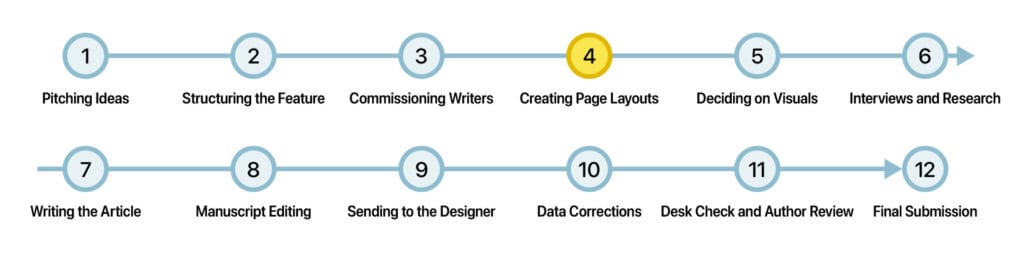
Once the page content is settled through discussions with the writer, the next step is creating page roughs. This is also the editor’s job.
Note for international readers: A rafu (ラフ, from the English “rough”) is a sketch or wireframe showing the basic layout of a page—where headlines, body text, and images will go. Unlike Western publishing where designers often have more autonomy, Japanese magazine editors frequently create detailed roughs that designers then execute, giving editors significant control over visual presentation.
A rough is like a blueprint for the page. Where does the headline go? Where does the body text flow? Where do the images fit? I work out the general layout. This process determines word counts and the number of images, enabling the writer to create their manuscript accordingly.
When I was starting out, I’d reference past articles from the same magazine when thinking about layouts. After doing this for several issues, my own patterns began to emerge.
Recently, though, I’ve been deliberately referencing other magazines. I wanted to shake up the feeling of a publication that had grown stale. Looking back, I wish I’d been bolder about making changes… but I did try to challenge myself with something new each issue.
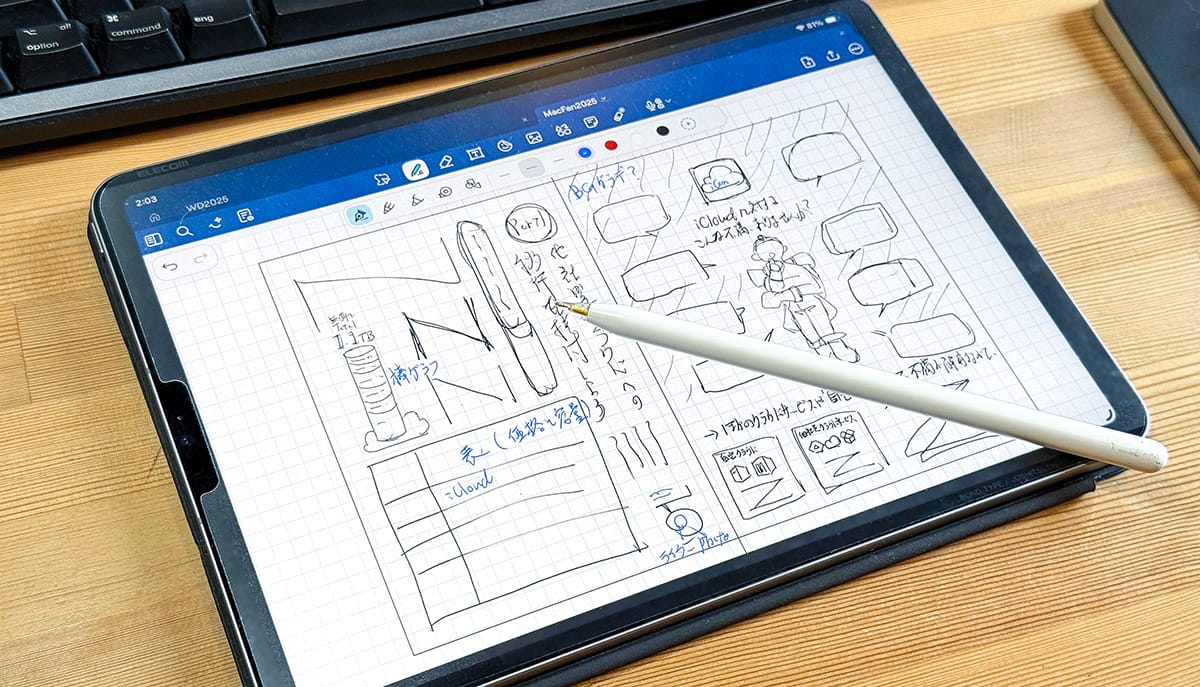
In the old days, I drew roughs by hand on paper. Now I sketch layout ideas roughly on iPad with Apple Pencil, then use that as the basis for designing in Adobe Illustrator. Tool preferences vary from editor to editor in this area.
5. Deciding on Visuals: Creating the “Face” of the Feature
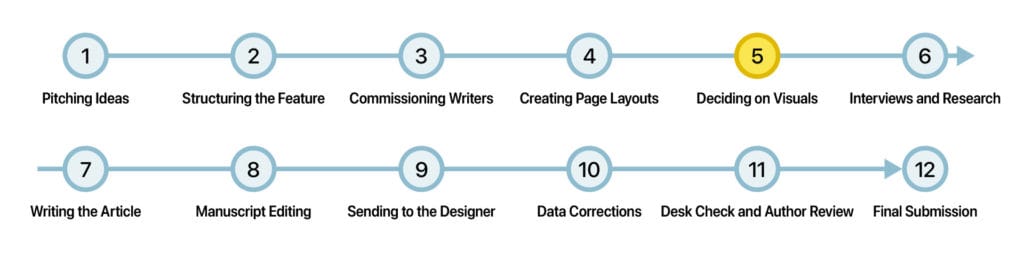
Parallel to developing content, I think about visuals. Every feature needs some kind of visual element. Will we go with photography or illustration? What should the content be?
After developing ideas, I meet with the designer to finalize the visual direction. Sometimes I’ll just announce “I’m thinking of doing it like this,” but often we decide collaboratively. During meetings with the designer, we also discuss the page layout composition. At this stage, though, it’s mainly about sharing the general “intent” or “tone”—like “I want it to feel like a video game strategy guide” or “I want it to feel like a fashion magazine.” Though honestly, at this point I often haven’t fully formed that vision myself…
Once the visual direction is set, we move into commissioning and arrangements.
For illustration, I select an illustrator and reach out. I communicate the deadline and rough scope, and confirm whether they can take on the work.
Once I receive confirmation, I convey the specific content. At this stage, I typically draw a rough sketch to communicate my vision. One thing I’m careful about here is not over-drawing. Since I draw as a hobby, I tend to get too detailed. Over-drawing can unduly influence the final result, and in some cases, it can make the illustrator uncomfortable. I’ve actually made this mistake before. I think I made them feel like I was encroaching on their professional territory. Now I’m careful to keep my sketches to the bare minimum needed to convey intent.
When using photography for visuals, preparation often becomes more complex. For shoots involving models, I work with talent agencies to select performers. Ideally you’d also arrange stylists and wardrobe, but budget constraints often meant asking models to provide their own outfits. There’s also location scouting and negotiation, plus arranging the photographer.
Note for international readers: In Japanese publishing, it’s common for editors to be involved in all aspects of photo shoot coordination, including model selection, location arrangements, and creative direction—tasks that might be handled by separate producers or art directors in larger Western publications.
Alternatively, we sometimes create visuals based on butsu-dori (物撮り)—product photography. In this case, the photographer shoots in the studio within the editorial office. It’s easier in that you don’t need to arrange models or locations, but you have to figure out how to create compelling visuals using product shots alone.
Note for international readers: Butsu-dori (literally “thing-shooting”) refers to still life or product photography, a staple of Japanese tech and hobby magazines. Creating visually engaging layouts from product shots alone is considered a distinct editorial skill.
6. Interviews and Research: Borrowing Expert Knowledge
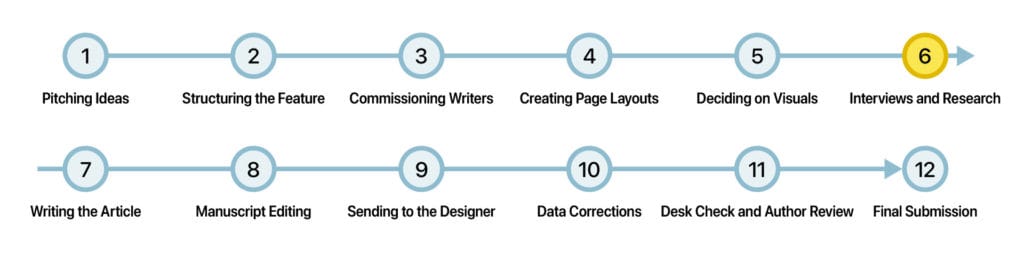
Depending on the article, we conduct interviews or field research with experts.
By the time I’ve created the proposal document, I already have an image of “what theme, and what kind of person I want to talk to.” If the interview subject is already clear, I send them a request directly.
On the other hand, sometimes the subject isn’t narrowed down yet. For example, cases like needing “an expert in PC desks and chairs.” In these situations, I consider who would best fit the editorial intent and use the internet and social media to compile a list of candidates.
The editor personally handles interview requests. I explain the project overview, interview content, and preferred dates, and make the ask.
Sometimes things come together smoothly; other times, days pass with no response. Magazines have deadlines, so even a few days of silence can cause serious anxiety. Ideally I’d send requests early, but reality doesn’t always cooperate.
Sometimes I commission a separate writer to write the interview article, but basically, I conduct the interview and write it up myself most of the time.
I used to conduct interviews in person, but after I moved to Nagano Prefecture, online interviews became my default. Not being able to take photos is a drawback, but conversely, I can now interview subjects regardless of where they live, which I think has worked out well. Of course, when photography is necessary, or when seeing the actual location is crucial to the story—not just the interview itself—I need to visit in person.
Note for international readers: Japan’s publishing industry has historically been heavily concentrated in Tokyo, making in-person interviews relatively convenient. Editors working remotely from other regions, as described here, remain somewhat unusual, though the COVID-19 pandemic accelerated acceptance of remote work practices.
Once an interview is scheduled, I prepare questions in advance and send them beforehand. Going into an interview unprepared is unthinkable. Well, I’ll admit there was a time when I did that, but expecting to wing it and rely on the subject’s improvisational skills—there’s no way that produces good articles.
Of course, on the day itself, I don’t just read off my prepared questions. When you listen with genuine interest in what the other person is saying, questions naturally arise, and you find yourself able to dig deeper into the conversation.
I’d like to write in detail about my interviewing approach somewhere, someday.
That’s it for Part 1. In Part 2, I’ll continue sharing the realities of the production process—how I work with manuscripts from writers, the kinds of issues that tend to come up when collaborating with designers, and the review process with writers and interview subjects. Stay tuned for Part 2.


